
The finding a parent will care about
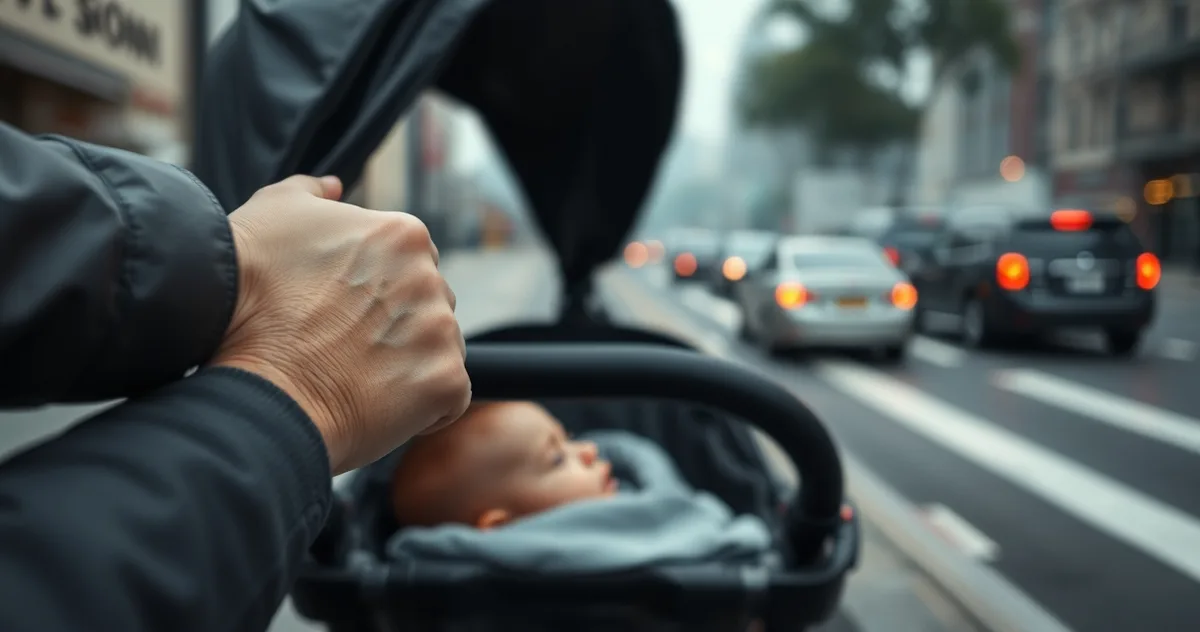
Babies who breathed dirtier air in their first year of life got sick more often. That is the plain version of what a team from Rome’s Bambino Gesu children’s hospital reported this spring. The more particle and traffic pollution an infant was exposed to, the more respiratory infections and wheezing episodes they had before their first birthday.
It is the kind of result that sounds obvious until you realize how little hard data exists on infants specifically. We know cigarette smoke is bad for tiny lungs. Ambient city air, the stuff nobody chooses to breathe, has been much harder to pin down at this age.
One caution up front, because it matters. This was presented as preliminary work at a medical meeting, not published as a finished, peer-reviewed paper. So read the numbers below as a strong early signal, not a closed case.
What the researchers actually did
The study followed infants enrolled in the Immune Development in Early Life cohort, IDEaL for short, in Rome. Each baby was examined in the clinic at 2, 5, 9, and 12 months, with phone check-ins in between, and their infections were recorded by a doctor rather than self-reported by a worried parent.
For pollution, the team didn’t strap monitors to babies. They took each family’s home postal code and linked it to nearby government air-quality stations to estimate how much of three pollutants the infant was exposed to over the year:
- PM10, coarse and fine particle pollution small enough to get deep into the airways.
- Nitrogen oxides (NOx) and nitrogen dioxide (NO2), gases that mostly come from traffic exhaust.
That postal-code method is worth flagging. It is a reasonable estimate, but it is not the same as measuring the actual air each baby breathed indoors and out. Keep that in your back pocket.
The numbers, translated
| Finding | Plain-English meaning |
|---|---|
| PM10 vs infections: r = 0.47 (p < 0.001) | The strongest link in the study. Babies exposed to more particle pollution clearly had more infections, and the odds this pattern is a fluke are under 1 in 1,000. |
| NOx and NO2 vs infections: r = 0.39 each (p < 0.001) | The two traffic gases tracked with infections too, a step below particles but still solid. |
| Wheezing: about r = 0.23 to 0.25 | Pollution lined up with wheezing as well, but more loosely than with full-blown infections. |
| Bronchiolitis, bronchitis, ear infections, COVID-19, tonsillitis: about r = 0.20 | Each specific illness showed a real but modest tie to dirtier air. |
| Number of infants: not reported | The team hasn’t published the sample size yet, so treat the strength of these links as provisional. |
A quick word on what “r = 0.47” means, since a raw correlation coefficient is useless to most people. It sits in the moderate range. Not a perfect lockstep, not noise either. It means pollution exposure and infection count moved together clearly enough that you would not expect to see it by chance. It does not mean pollution explains all, or even most, of why a given baby got sick.
Why the “correlation is not causation” line actually bites here
This is the part most headlines will skate past, so let me be blunt about it. A study like this cannot tell you that the pollution caused the infections. It can only tell you the two rose and fell together.
The problem is everything else that travels alongside dirty air. Babies in high-pollution postal codes are more likely to live near busy roads, in denser and sometimes older housing, in households with different income and childcare patterns. Any of those could drive infection rates on their own. The researchers found a link. They did not, and with this design could not, isolate pollution as the cause.
That does not make the finding weak. It makes it a signal that points somewhere worth digging, which is exactly how good epidemiology starts.
The claim that goes one step too far
One of the researchers, Dr. Donato Amodio, suggested the air a baby breathes in year one may not just affect the lungs but “permanently influence the development of their immune defenses.” That is a genuinely interesting idea, and it fits a wider theory that the first year is a formative window for the immune system.
But notice what happened there. The study measured infections and wheezing over twelve months. It did not measure immune development, and it certainly did not track anything permanent. The permanent-immune-imprint idea is a hypothesis the team is raising, not a result they demonstrated. Worth watching, not worth repeating as fact.
The gaps that keep this preliminary
- No sample size on the table. Without knowing how many infants were studied, you cannot judge how sturdy a correlation of 0.47 really is. A big cohort makes it convincing; a small one makes it fragile.
- Exposure was estimated, not measured. Postal-code air-quality data is a proxy. It misses indoor air, time spent away from home, and how much any individual baby was actually outside.
- Not yet peer-reviewed. Conference abstracts get revised, and sometimes walked back, before they become published papers. The full write-up may change these numbers.
- Mechanism is unknown. The team openly said more work is needed to understand how pollutants might weaken an infant’s defenses. Right now that link is a black box.
None of this sinks the study. It just means the honest headline is “a clear association worth investigating,” not “pollution is making your baby sick.”
What to do with this if you have an infant
You cannot personally fix a city’s air, and it would be unfair to load that guilt onto any parent. But the dose a baby gets is partly local, and some of that you can influence:
- Cut the obvious sources first. No smoking or vaping anywhere near the baby, indoors or in the car. That effect is far larger and better proven than ambient pollution.
- Mind the traffic. Avoid long stretches next to idling or heavy traffic with a pram, and keep the stroller cover or a barrier up on bad-air days.
- Clean the indoor air you control. A HEPA air purifier in the baby’s room helps on high-pollution days, and keeping windows shut when outdoor air quality is poor is a cheap move.
- Check local air-quality alerts. Most cities publish a daily index. On the worst days, keep outdoor time short.
- Don’t panic over one study. This is one preliminary cohort. If your baby gets the usual run of coughs and colds, that is normal infancy, not proof of harm from the air.
The useful takeaway is small but real. Early-life air probably matters more than we’ve been able to prove, and the low-effort steps to reduce a baby’s exposure are worth taking anyway.
Sources:
- eurekalert.org, “Ambient air pollution is associated with respiratory infection burden in the first year of life” (https://www.eurekalert.org/news-releases/1125605)
- cidrap.umn.edu, “Air pollution linked to recurrent respiratory infections in infants” (https://www.cidrap.umn.edu/misc-emerging-topics/air-pollution-linked-recurrent-respiratory-infections-infants)
Disclaimer: This article is for general information only and does not constitute medical advice, diagnosis, or treatment. Always consult a qualified healthcare provider about any medical condition or before making health decisions.