
A good idea that did not survive the big test
A sickle cell pain crisis is one of the worst kinds of pain in medicine. Sickled red cells jam up small blood vessels, tissue starves for oxygen, and the result can put a child in hospital on a morphine drip for days. Anything that could make those days shorter would matter to a lot of families. For a while, a cheap amino acid called arginine looked like it might.
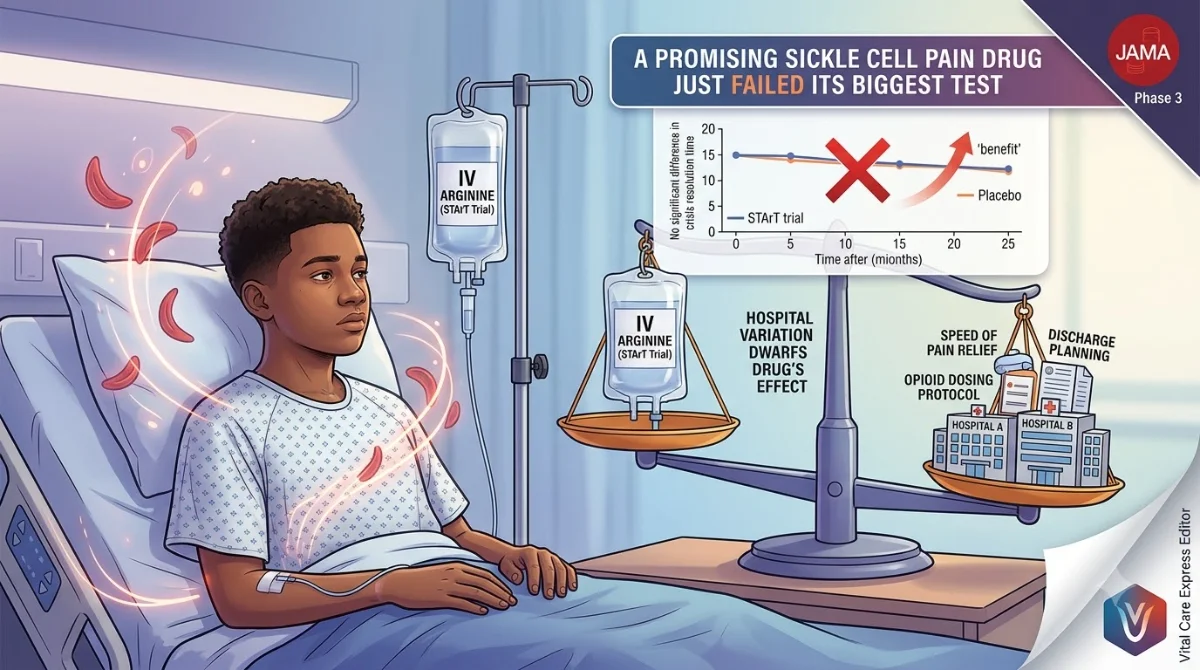
It does not. A new phase 3 trial published in JAMA gave intravenous arginine to children and young adults during a crisis and found it did not shorten the crisis at all. The result was clear enough that the trial was stopped early. And buried in the data is a second finding that is arguably more useful than the first: which hospital a child was treated in mattered more to how long their crisis lasted than whether they got the drug or a saltwater placebo.
That is a hard result to sell as good news, but it is honest, and it points somewhere real.
| Finding | Plain-English meaning |
|---|---|
| Arginine median 60.8 hours vs placebo 65.8 hours to crisis resolution | The two groups took about the same time to recover; the small gap could easily be chance. |
| Difference 7.2 hours, range from 21.6 hours faster to 35.9 hours slower | The statistical range crosses zero, so there is no reliable benefit. |
| 271 children and young adults treated (129 arginine, 142 placebo) | A large trial for this disease, not a small pilot, which makes the null result hard to dismiss. |
| No difference in opioid use, pain scores, patient-reported outcomes, or safety | Arginine did not lower how much pain medicine children needed, and it did not cause new harm. |
| Trial halted early for futility | Once it was clear the drug was not helping, continuing would have exposed more children to no benefit. |
| Crisis length varied more between hospitals than between drug and placebo | How care is delivered locally may move the needle more than this specific drug. |
What the trial actually did
The study is called STArT, short for Sickle Cell Disease Treatment with Arginine Therapy. It ran through the Pediatric Emergency Care Applied Research Network at 10 children’s hospitals across the United States, enrolling patients from June 2021 to June 2024. The people in it were young, a mean age of about 14, ranging from 3 to 21 years old, and 92% were Black, which reflects who sickle cell disease affects most in the US.
When a child arrived in crisis, they were randomly assigned to get either intravenous arginine, a loading dose followed by more every eight hours until discharge, or a matching placebo. Nobody, not the family and not the treating team, knew which one a given child received. Then the researchers measured the thing that matters to a family stuck in a hospital room: how long until the crisis resolved and the child could go home.
The number that decides it
For the arginine group, the median time to resolution was 60.8 hours. For placebo, it was 65.8 hours. On the surface that is a five-hour edge for the drug, which sounds like something.
It is not. The reported difference was 7.2 hours, but the statistical range around it ran from arginine looking about 22 hours better to about 36 hours worse. When the range of plausible truth stretches from clearly helpful to clearly harmful and passes straight through zero, the honest reading is that the drug did nothing measurable. Every other yardstick agreed. There was no difference in how much opioid pain medicine children needed, no difference in their pain scores, no difference in what patients reported about their own recovery, and no difference in safety events.
That last point is worth holding onto. Arginine failing to help is not the same as arginine causing harm. It appears to be a safe drug that simply does not do this particular job.
Why a sensible idea can still be wrong
The reasoning behind arginine was not a shot in the dark. During a crisis, people with sickle cell disease burn through arginine, the building block their bodies use to make nitric oxide. Nitric oxide is one of the signals that tells blood vessels to relax and stay open, exactly the thing that goes wrong when sickled cells clog a vessel. Replace the missing arginine, the thinking went, restore some nitric oxide, and the crisis should ease sooner. A smaller phase 2 study had even hinted at a benefit.
This is how medicine is supposed to work. A plausible mechanism plus an encouraging early signal earns a proper trial, and the proper trial is allowed to say no. Small early studies overpromise all the time, which is the entire reason large randomized trials exist. STArT is the system catching an idea before it hardened into routine practice on the strength of hope.
The finding hiding underneath the headline
The part of this study that should travel further than “drug fails” is the variation between hospitals. Crisis length swung more depending on where a child was treated than on which arm of the trial they were in. A drug that does nothing, and a hospital effect that does something, sitting in the same dataset.
That is a lead, not a footnote. It suggests the biggest available gains in sickle cell crisis care right now may not be a new molecule at all. They may be the unglamorous operational things that already differ from one hospital to the next: how fast a child in pain gets their first strong dose, whether opioids are dosed to a protocol or by guesswork, how hydration and oxygen are managed, and when a team decides someone is well enough to leave. Those are fixable without inventing anything.
What this study cannot tell you
- It stopped early. Halting for futility is the right call ethically once a drug is clearly not helping, but an early stop means fewer patients and slightly less certainty than a trial run to its planned end. The signal here was strong enough that this is a minor caveat, not a fatal one.
- It was children and young adults. The oldest participants were 21. It does not directly answer whether arginine helps adults in crisis, though there is little reason to expect a different result.
- It measured one specific use. This was arginine given during a crisis to shorten that crisis. It does not rule out other roles for arginine in sickle cell care that were not tested here.
- It cannot explain the hospital gap. The trial shows that where you are treated mattered; it does not pin down exactly which local practices drove the difference. That takes a different kind of study.
What to do with this if sickle cell is in your family
- Do not chase arginine for crisis relief. The best current evidence says it will not get you or your child home sooner. If a clinician proposes it for that reason, this trial is fair to raise.
- Focus on how fast and how well pain is treated. Since the hospital mattered more than the drug, the questions worth asking are practical ones: how quickly will pain be treated on arrival, is there a written pain protocol, who manages the crisis. Speed and consistency of pain control are where the real gains seem to be.
- Keep the safety point in perspective. Arginine did not harm children in this trial. The problem is not danger, it is that it does not work for this, so it is not worth pinning hopes on.
- Watch the real advances elsewhere. The genuine progress in sickle cell disease right now is in disease-modifying treatments, not in speeding up individual crises with an amino acid. That is where to keep an eye.
The short version: a reasonable, cheap, safe idea got its fair test at scale and came up empty, and the more valuable clue was the one nobody was looking for, that the system treating the child may matter more than the drug in the bag.
Related Coverage
- FDA Approves First Gene Therapy for Young Children with Sickle Cell Disease
- Most surgery patients still wake up in pain, drug packs aren’t a cure-all
Sources:
- JAMA, “Arginine Therapy for Sickle Cell Disease Acute Pain Episodes: The STArT Randomized Clinical Trial” (https://jamanetwork.com/journals/jama/article-abstract/2853065)
- Trials, “Sickle Cell Disease Treatment with Arginine Therapy (STArT): study protocol for a phase 3 randomized controlled trial” (https://trialsjournal.biomedcentral.com/articles/10.1186/s13063-023-07538-z)
- Medical Dialogues, “Arginine Therapy fails to shorten Sickle Cell pain crises, suggests study” (https://medicaldialogues.in/pediatrics-neonatology/news/arginine-therapy-fails-to-shorten-sickle-cell-pain-crises-suggests-study-177785)
Disclaimer: This article is for general information only and does not constitute medical advice, diagnosis, or treatment. Always consult a qualified healthcare provider about any medical condition or before making changes to your care.