
A twenty-year idea finally clears the bar
For decades, the idea of a cancer vaccine that trains your own immune system to finish off a tumour has been one of oncology’s most tantalising near-misses. It made sense on paper, it worked in mice, and it kept falling short in the trials that count. On August 19, 2026, Merck and Moderna said one has finally cleared the highest bar in medicine: a phase 3 trial.
Their vaccine, intismeran autogene, is built fresh for each patient from their own tumour. Added to the immunotherapy Keytruda after surgery for melanoma, it cut the chance of the cancer coming back compared with Keytruda alone, across 1,137 patients. No individualized cancer vaccine had ever won a trial this large before. Professor Georgina Long, who ran the study and directs the Melanoma Institute Australia, called it “a landmark moment for adjuvant melanoma treatment.”
There is a catch worth being honest about from the start, and we will get to it: the companies announced that the vaccine worked without actually showing how well.
| Finding | Plain-English meaning |
|---|---|
| First phase 3 win for a personalized cancer vaccine | The approach has cleared the largest, strictest kind of trial for the first time, not just an early-stage hint. |
| 1,137 patients with resected stage IIB-IV melanoma | A large trial in people whose melanoma was removed but carried a high risk of returning. |
| Vaccine added to Keytruda beat Keytruda alone | Fewer cancers came back when the custom vaccine was added to standard immunotherapy. |
| Up to 34 neoantigens coded into each shot | The vaccine is tailored to the exact mutations in one person’s tumour, using COVID-style mRNA. |
| Actual phase 3 numbers not yet released | The companies say it worked with statistical confidence, but held back the hazard ratios and event rates. |
| Earlier phase 2 cut recurrence risk about 49% | In the smaller predecessor trial over five years, adding the vaccine roughly halved the risk of recurrence or death. |
What the trial did
The study, called INTerpath-001, enrolled 1,137 people whose cutaneous melanoma had been surgically removed but was high risk, stage IIB through IV, meaning it had grown deep or spread to nearby nodes and had a real chance of coming back. None had received prior systemic therapy. They were split two to one: two-thirds got the personalized vaccine plus pembrolizumab (the drug sold as Keytruda), and one-third got pembrolizumab alone, which is already a standard treatment in this setting.
The main question was recurrence-free survival, how long patients went without their cancer returning. A key second question was distant metastasis-free survival, how long they went without the cancer spreading to distant organs. The trial met both. Merck’s Dr. Dean Y. Li, president of Merck Research Laboratories, said the findings “reinforce the promise of a more personalized approach to cancer treatment.”
How a vaccine gets built for one person
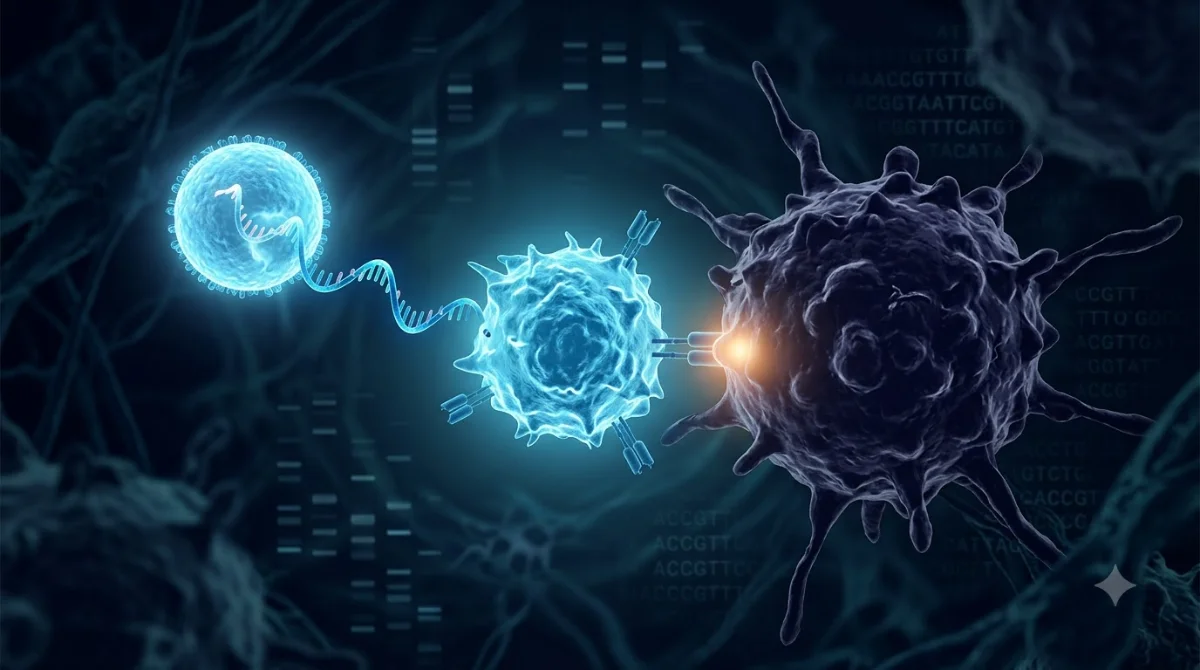
This is the part that still sounds like science fiction. When a patient’s tumour is removed, a sample is sequenced to map the specific mutations that make that cancer distinct from the person’s healthy tissue, its molecular fingerprint. Up to 34 of those mutation markers, the neoantigens, are then written into a strand of synthetic mRNA, the same class of technology that powered the COVID vaccines. Injected back into the patient, the mRNA instructs their cells to display those cancer flags, and the immune system learns to recognise and attack any remaining cell carrying them.
Every dose is therefore a different product, manufactured for a single human being. That is the source of both the promise and the practical headache, which we will come back to.
The honesty problem with this announcement
Here is the catch. The companies announced that INTerpath-001 hit its goals with a “statistically significant and clinically meaningful” improvement, but they did not release the actual hazard ratios, the survival percentages, or the absolute difference in how many people relapsed. Overall survival, whether the vaccine helps people live longer, is not yet mature and was not reported at all.
That matters, because “met its endpoint” and “changed patients’ lives by a lot” are not the same statement. A result can be statistically real and still modest in size. Until the full data is presented, the strongest hard numbers we actually have come from the earlier, smaller phase 2 trial, KEYNOTE-942. In that study, with five years of follow-up, adding the vaccine cut the risk of recurrence or death by 49% (hazard ratio 0.51) and the risk of distant spread by 59% (hazard ratio 0.411). Those figures are genuinely striking, but they are from roughly 150 patients, not the 1,137 here. Whether the big trial matches that early magnitude is exactly the number being withheld.
The companies say they will present the full data at an international medical meeting and take it to regulators to begin the approval process. That is when this story can be properly judged.
What this study cannot tell you yet
- The size of the benefit is undisclosed. We know it worked. We do not yet know by how much in the phase 3, and that gap is the whole ballgame for a treatment this complex and expensive.
- It does not yet show people live longer. Overall survival data is not mature. Preventing recurrence is a strong sign, but the ultimate test, more years of life, is still pending.
- It is one cancer, in one situation. This was melanoma after surgery. The same approach is in trials for lung and kidney cancer, but those have not read out. Do not assume this result transfers.
- Making it is hard. A bespoke vaccine per patient means sequencing a tumour, designing and manufacturing a unique product, and delivering it in time. That is a real barrier to cost and to who can actually get it, even if approved.
- Safety looks reassuring but is thin on detail. The companies report no new safety signals beyond what the combination already showed, which is good, but the detailed safety breakdown has not been published.
What to take from it if melanoma is in your life
If you or someone close has had melanoma removed and is weighing what comes next, this is encouraging news, not an option you can act on today. The vaccine is not approved and is not available outside trials. What the result does is strengthen the case for staying in the loop with a specialist melanoma centre, because personalized approaches like this move through approval one step at a time, and clinical trial access is often the earliest route in. It is fair to ask an oncologist whether any neoantigen or mRNA vaccine trials are open and suitable.
For everyone else, the honest headline is the interesting one. A cancer vaccine idea that spent twenty years almost working has, for the first time, won the kind of trial that changes practice. That is real. The measure of exactly how much it helps is coming, and it is worth waiting to see before deciding how loud to cheer.
Related Coverage
Sources:
- Merck, “Merck and Moderna Announce Phase 3 INTerpath-001 Trial of Intismeran Autogene Plus KEYTRUDA Met Endpoints of RFS and DMFS in Patients With Completely Resected Stage IIB-IV Melanoma” (https://www.merck.com/news/merck-and-moderna-announce-phase-3-interpath-001-trial-of-intismeran-autogene-plus-keytruda-met-endpoints-of-recurrence-free-survival-rfs-and-distant-metastasis-free-survival-dmfs-in-patient/)
- The ASCO Post, “INTerpath-001 Trial of mRNA-Based Individualized Neoantigen Therapy Meets Primary and Key Secondary Endpoints in Patients With High-Risk Resected Melanoma” (https://ascopost.com/news/august-2026/interpath-001-trial-of-mrna-based-individualized-neoantigen-therapy-meets-primary-and-key-secondary-endpoints-in-patients-with-high-risk-resected-melanoma/)
- OncoDaily, “INTerpath-001 Trial: Personalized mRNA Cancer Vaccine for Melanoma” (https://oncodaily.com/oncolibrary/immune-oncology/interpath-001)
Disclaimer: This article is for general information only and does not constitute medical advice, diagnosis, or treatment. Always consult a qualified healthcare provider about any medical condition or before making changes to your care.