
The claim, and why this one is worth a second look
Most “gut bacteria linked to X” headlines are pure correlation. A study finds a bug is more common in healthy people, and the story writes itself while the actual proof stays thin. This one is different in a specific way, and that difference is the whole reason to pay attention.
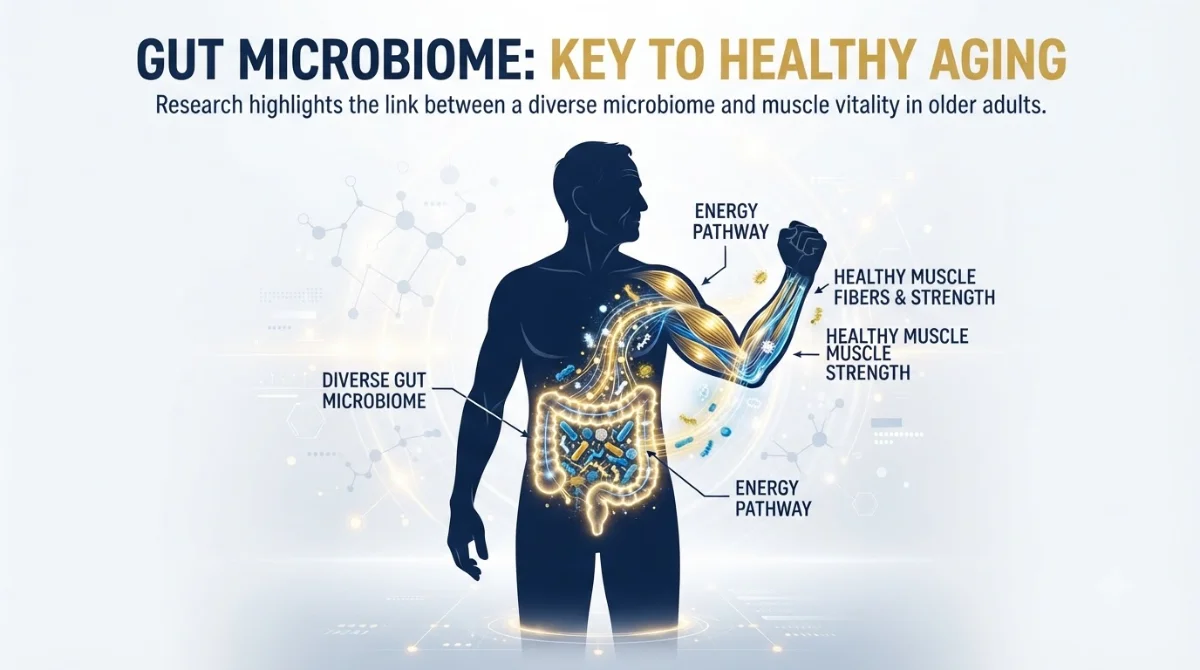
Researchers tied a single gut microbe, Roseburia inulinivorans, to noticeably stronger grip in older adults. Then they took the extra step most of these studies skip. They gave the bacterium to mice and watched the animals get stronger. Human association plus an animal experiment is a sturdier bridge than either alone.
It still is not proof that a pill will make you stronger. But it is a good deal more than a lucky pattern in one dataset.
| Finding | Plain-English meaning |
|---|---|
| Older adults with Roseburia inulinivorans had about 29% higher grip strength | A large strength gap tied to the presence of one gut microbe. |
| The human half was 90 young adults and 33 older adults, observational | A small older group, and this part can show a link, not a cause. |
| Only some Roseburia species tracked with strength, not all | The signal is specific, which is reassuring: it looks real, not like random noise. |
| The team also fed the bacterium to mice, which grew stronger | The animal experiment is the step most gut studies skip, a sturdier bridge than association alone. |
| Published in the journal Gut in 2026 | A serious gastroenterology journal, not a fringe outlet. |
Who ran it and what they measured
The work came out of a collaboration led by the University of Granada and the University of Almeria in Spain, with Leiden University Medical Center and the University of Groningen in the Netherlands, published in the journal Gut in 2026. Gut is a serious gastroenterology journal, not a fringe outlet, which matters for how much weight to give this.
They looked at two groups of people. Ninety young adults aged 18 to 25, and 33 older adults aged 65 and up. They sequenced each person’s gut microbiome from stool samples, then lined that up against real strength tests: handgrip, leg press, bench press, and maximal oxygen uptake during exercise.
Two things to flag right away. The older-adult group is small, just 33 people. And this human half is observational, so it can show a link, not a cause.
The human findings
The standout number: older adults who had Roseburia inulinivorans detectable in their stool had about 29% higher handgrip strength than those who did not. That is a large gap for a single microbe to be associated with.
In the young adults, more of the same bacterium lined up with stronger grip and better cardiorespiratory fitness. A related species, Roseburia intestinalis, tracked with leg and upper-body strength in that younger group. Two other Roseburia species showed nothing, which is actually reassuring: if every bug in the family lit up, you would suspect noise rather than a real signal.
So within the human data, the pattern is specific and it points one direction. Specific and one-directional is better than broad and mushy. It is still association.
The mouse experiments, where it gets interesting
Here is the part that lifts this above the usual correlation story.
| What the mice showed after getting the bacterium | Result |
|---|---|
| Forelimb grip strength | Roughly 30% increase |
| Muscle fiber size | Larger fibers |
| Fiber type | Shift toward fast-twitch (type II) fibers |
| Muscle energy machinery | Changes in proteins and enzymes tied to energy production |
Because the researchers gave the microbe directly and then saw strength climb, this is closer to cause and effect than anything the human snapshot can offer. Two co-authors framed it that way. Jonatan Ruiz of the University of Granada said the results “provide solid evidence confirming the existence of a gut-muscle axis,” and Borja Martinez Tellez of the University of Almeria said the bacterium “could be used as a probiotic to help preserve muscle strength during aging.”
Read those quotes carefully though. “Could be used.” Not “is.” Even the people who ran it are keeping the claim in the conditional.
The catches nobody should skip
The honest limits here are important, and the team names them.
- The human strains did not permanently colonize the mice. The bacterium boosted strength during the experiment, but it did not settle in and stay. That complicates any simple “just take this probiotic forever” picture.
- The older human cohort is tiny. Thirty-three people is enough to spot a strong signal, not enough to be sure it holds across the wider population.
- The mechanism is not nailed down. The study reports changes in muscle energy proteins, but the primary release does not spell out the exact pathway from a gut microbe to a stronger muscle.
- No inflammatory or nerve-signaling pathways were directly tested, and the authors say long-term work is still needed to sort cause from correlation.
None of this sinks the finding. It just means “gut-muscle axis exists and this bug is a strong lead” is the correct reading, while “take a Roseburia supplement to get strong” is getting ahead of the evidence by a wide margin.
Why the target matters
Grip strength is not a gym-bro vanity metric. It is one of the most reliable simple predictors of how someone ages: weaker grip tracks with frailty, disability, and higher mortality risk. And age-related muscle loss, sarcopenia, is a genuine driver of falls and lost independence in older people.
That is what makes a microbe linked to preserving strength genuinely worth chasing. If a specific gut bacterium can be encouraged, or one day delivered, to protect muscle in aging bodies, the payoff is not cosmetic. It is people staying on their feet and out of care longer.
What to actually do with this today
Very little, and that is the honest answer.
- Do not go buy a “Roseburia” supplement. No such product has been tested for strength in people, and the mouse strains did not even stick around. You would be paying for hope.
- The boring advice still wins. Roseburia species are fiber-fermenters that generally do better on a plant-rich, high-fiber diet. That is standard microbiome knowledge, not a result of this study, but it costs nothing and helps your gut regardless.
- Keep lifting and moving. Resistance exercise remains the proven way to hold muscle as you age. A gut microbe might one day assist that. It will not replace it. The supplement shortcuts are weaker than the marketing: the evidence for collagen and muscle strength is mixed at best, and even everyday habits like coffee only track with body composition, they do not cause it.
- Watch this space, not your wallet. This is a strong signal that earns a proper human trial. Treat it as a promising lead, and let the trials decide before spending on it.
The short version: a single gut bug was linked to much stronger grip in older people, and giving it to mice made them stronger, which is real and unusual for this kind of study. It is a compelling case that your gut and your muscles talk to each other. It is not, yet, something you can buy your way into.
Sources:
- ugr.es, “Bacteria found in the human intestine capable of improving muscle strength” (https://www.ugr.es/en/about/news/bacteria-found-human-intestine-capable-improving-muscle-strength)
- sciencedaily.com, “This gut microbe may help keep you strong as you age” (https://www.sciencedaily.com/releases/2026/08/260820202904.htm)
Disclaimer: This article is for general information only and does not constitute medical advice, diagnosis, or treatment. Always consult a qualified healthcare provider about any medical condition or before starting a supplement or exercise program.